Cast Your Bread Upon the Waters
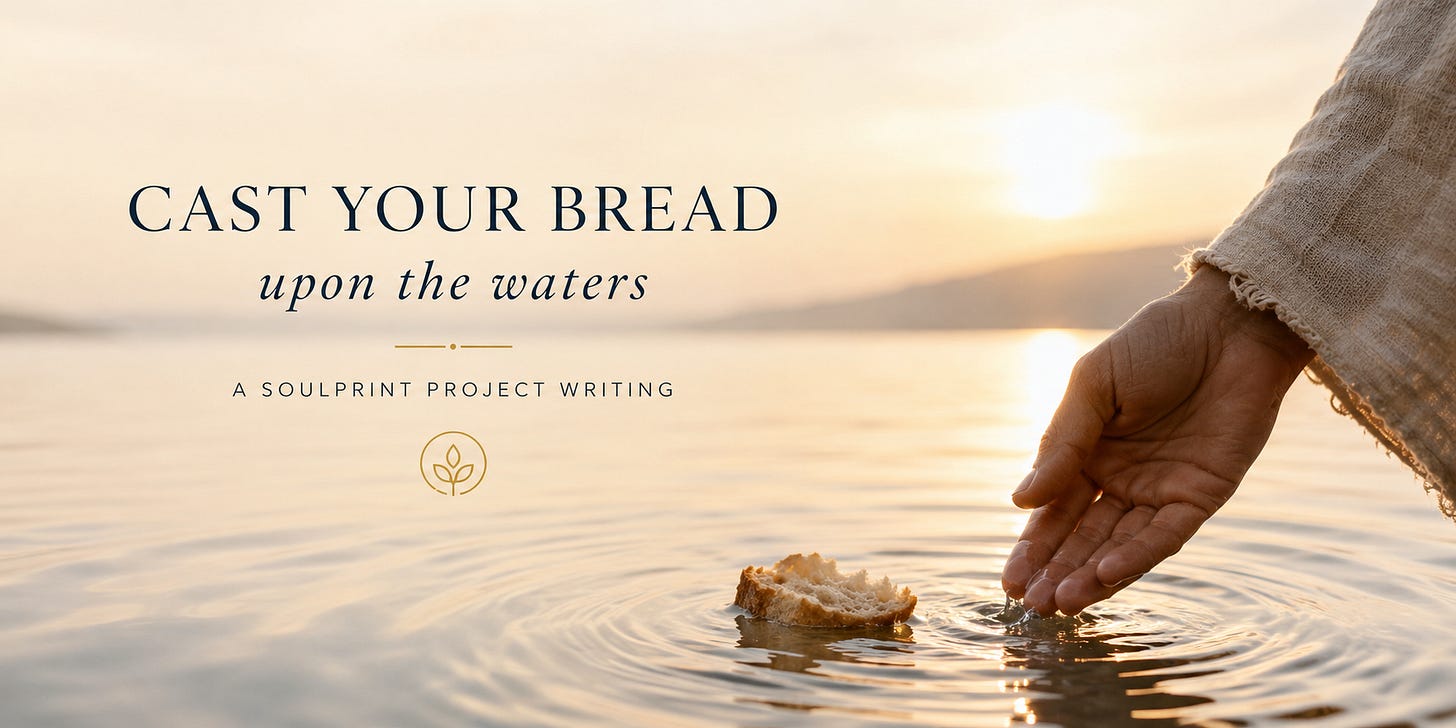 Cast Your Bread Upon the Waters
by J. Steve Bruner
On my father, the indignity of suffering, and the strange arithmetic of God
“Cast thy bread upon the waters: for thou shalt find it after many days.”
— Ecclesiastes 11:1
There are things about growing old that no young man can understand.
There are things about suffering that no healthy man can understand.
And there are things about watching your father suffer that no son can understand until he finds himself standing beside the bed.
My father has always been what an earlier generation would simply have called a man’s man.
Proud, independent, accomplished, strong-willed. A man accustomed to standing on his own two feet, making his own decisions, solving his own problems, and carrying his own burdens without asking the world to feel sorry for him.
And then sickness comes.
Sickness has no respect for the mythology we construct around ourselves.
It does not ask about your accomplishments.
It does not care what degrees hang on your wall, how much money is in your account, what position you once held, how many people respected you, or how fiercely independent you have been.
The body begins making demands.
And suddenly a proud man must allow strangers to do things for him that, not so many months or years before, would have been unimaginable.
Clothes disappear.
Privacy disappears.
Control disappears.
Someone measures this.
Someone records that.
Someone asks when you last went to the bathroom.
Someone decides whether you are strong enough to stand.
Someone else decides whether you qualify for another few days of care.
The great mysteries of a human life are somehow reduced to charts, medications, oxygen levels, insurance codes, reimbursement rules, therapy minutes, and somebody clicking boxes on a computer screen.
And standing there as a son, watching it happen to your father, something inside you wants to scream:
Is this really the best we can do?
Where are all the geniuses?
Where are all the brilliant people who built rockets, mapped the genome, created artificial intelligence, split atoms, transplanted hearts, and placed telescopes in space capable of looking billions of years into the past?
How can humanity be so astonishingly intelligent and yet sometimes seem so terribly confused about what to do with a fragile old man lying in a bed?
Perhaps Dostoevsky understood something we would rather not admit: civilization can become extraordinarily sophisticated without necessarily becoming wise.
We can learn how to extend life without ever answering the question of what makes a life worth living.
And suffering has a terrible way of exposing the difference.
The Strange Arithmetic of God
As I have watched my father, however, another thought keeps returning to me.
It comes from Ecclesiastes:
“Cast thy bread upon the waters: for thou shalt find it after many days.”
What a ridiculous sentence.
Think about it literally.
Take something valuable, your bread, your sustenance, perhaps the very thing you need to survive, and throw it into the water.
What happens?
It becomes soaked.
It dissolves.
Fish eat it.
The current carries it away.
By every ordinary calculation, it is gone.
A man concerned only with keeping accounts would never do such a thing.
He would clutch the bread.
Protect the bread.
Store the bread.
Count the bread.
Insure the bread.
Invest the bread.
He would construct barns to hold the bread and perhaps larger barns when those became insufficient.
Jesus once told a story about such a man.
His crops had produced abundantly, so the man said to himself:
“I will pull down my barns, and build greater.”
Then he congratulated himself.
Soul, thou hast much goods laid up for many years.
And God answered:
“Thou fool, this night thy soul shall be required of thee.”
There is the arithmetic of the world.
And there is the arithmetic of God.
They are not the same mathematics.
The world says:
Keep.
God says:
Give.
The world says:
Accumulate.
God says:
Scatter.
The world says:
Protect yourself.
God says:
Love your neighbor.
The world says:
What will I get in return?
God says:
Cast your bread upon the waters.
And perhaps the greatest tragedy is that we can spend an entire lifetime balancing the wrong ledger.
My Father Cast His Bread
Looking back over my father’s life, I realize that this may be one of the best ways I know to describe him.
He cast his bread upon the waters.
Not perfectly.
I want to be very clear about that.
I am not canonizing my father.
He is a man.
He has faults.
He has made mistakes.
He has probably hurt people without intending to hurt them, misunderstood people, made poor decisions, and carried the contradictions that all of us carry.
There has only been one perfect life.
But perhaps holiness was never about becoming flawless.
Perhaps it is about something much deeper.
Perhaps holiness begins when a human being gradually yields himself to a reality greater than himself.
Some people do that.
I have known them.
You probably have too.
They are difficult to explain because they don’t necessarily look extraordinary.
They may never become famous.
Their names may never appear in history books.
But something about them seems to create ripples.
They encourage someone.
They educate someone.
They forgive someone.
They give someone another chance.
They trust a person everyone else has written off.
They quietly pay for something.
They introduce two people whose meeting changes both their lives.
They sit beside a hospital bed.
They give advice that isn’t remembered until twenty years later.
They love a child who grows up and loves another child.
They cast their bread.
And then they forget where they threw it.
That may be the secret.
Because the person who keeps looking downstream to see whether his bread has returned has not completely given it away.
The People Who Live by Another Measure
There are people who spend their lives inside the endless chatter of calculation.
What do I have?
What do you have?
What do I deserve?
What am I owed?
Who received more?
Who received less?
What does this cost me?
What will I get back?
Their internal books must always balance.
I understand this way of living because there is some of it in every one of us.
Fear keeps excellent records.
Ego is an obsessive accountant.
But occasionally you encounter another kind of human being.
They seem to have discovered another economy altogether.
Grace.
They give when giving makes little sense.
They trust when trust carries risk.
They forgive when resentment would be understandable.
They see possibilities in people others have already dismissed.
They somehow understand that the deepest things in life cannot be placed on a balance sheet.
Love cannot.
Mercy cannot.
Courage cannot.
Faithfulness cannot.
Beauty cannot.
Friendship cannot.
Grace cannot.
The soul cannot.
And God certainly cannot.
These people live what I can only call transcendent lives.
Not because they escape ordinary life.
Quite the opposite.
They enter it more deeply.
They discover something about who God created them to be, and slowly, often painfully, they become that person.
That is Soulprint.
And when it happens, even imperfectly, there is a glory about a human life that cannot be measured by anything this world possesses.
God’s People Have Always Looked Slightly Insane
Read Scripture carefully, and you discover that God seems strangely fond of people who make very poor sense on paper.
Abraham was seventy-five when God told him:
“Get yourself and your family out of thy country… unto a land that I will show you.”
Leave everything familiar.
Go somewhere I will show you later.
That is not a business plan.
That is faith.
Moses spent decades in the wilderness tending sheep after his life in Pharaoh’s world had collapsed.
Forty years.
Imagine the conversations Moses must have had with himself.
This is what became of me?
This is my life?
Sheep?
And then, when Moses was an old man, God appeared in a bush that burned without being consumed.
History changed.
Jacob was a deceiver.
His very name carried the scent of grasping and manipulation.
Then one night he wrestled with God until daybreak.
He walked away wounded.
Limping.
But carrying a new name:
Israel.
And somehow the wound and the blessing came together.
That seems to happen often with God.
Then there is Judah and Tamar.
Read that story sometime without sanitizing it.
It is uncomfortable.
Morally complicated.
Scandalous.
Hardly the genealogy one would invent for the Messiah, our Jesus.
And yet Matthew deliberately includes Tamar when he tells us the genealogy of Jesus.
Think about that.
God did not erase the scandal from the family tree.
He redeemed it.
Which brings us to one of the most important sentences in Scripture:
“For my thoughts are not your thoughts, neither are your ways my ways, saith the Lord.” - Isaiah 55:8
We should probably write that over the door of every church.
And perhaps every hospital.
And certainly over the doorway of our own minds.
God’s ways are not our ways.
Francis Asked Two Questions
And somehow, whenever I follow these thoughts far enough, I come back to Francis.
St. Francis of Assisi has long been my patron saint.
Near the end of his life, Francis was no romantic garden statue surrounded by birds.
His body was failing.
He suffered terribly.
His eyesight deteriorated.
He bore wounds.
The man who sang of Brother Sun and Sister Moon eventually had to confront the same terrible mystery awaiting every one of us:
the surrender of the body.
Yet Brother Leo reportedly overheard Francis praying through the night, circling around two astonishingly simple questions:
Who are You, my God?
And:
Who am I?
Dietrich Bonhoeffer, facing execution, wrote his famous poem Who Am I, this or another, just days before being hanged, but it ends with: Whoever I am, thou knowest, God; I am thine.
Perhaps those are the only two questions that finally matter.
Not:
How successful was I?
How much did I accumulate?
Did everyone understand me?
Did I win?
Was life fair?
Did I receive everything I deserved?
But:
Who are You, God?
And:
Who am I?
The two questions are inseparable.
Because I cannot finally know myself without knowing the One in whose image I was created.
And perhaps I cannot truly encounter God without eventually confronting the false person I have constructed to survive without Him.
Francis found his answer staring at Christ crucified.
There is something almost unbearable about that.
Because Christianity does not offer us a God safely removed from suffering.
It gives us a naked man hanging on a cross.
Humiliated.
Exposed.
Wounded.
Dependent.
Mocked.
His dignity seemingly stripped away.
And Christianity makes the outrageous claim:
There is God.
Which means that perhaps dignity cannot actually be taken from a human being.
Clothing can be taken.
Strength can be taken.
Independence can be taken.
Health can be taken.
Possessions can be taken.
Memory can be taken.
Eventually life itself can be taken.
But the Imago Dei remains.
The image of God is deeper than the body that carries it.
Watching My Father
And so I stand beside my father differently now.
Yes, I still become angry.
I still question systems.
I still wonder why things that should be simple become complicated and why people sometimes seem to serve procedures rather than persons.
I still want better.
But beneath all of that, something else is happening.
I am watching the tide come in.
And scattered across those waters is bread my father threw there years ago.
I see pieces of it returning in people.
In stories.
In gratitude.
In relationships.
In lives he touched and perhaps never realized he touched.
A kindness here.
An opportunity there.
A person he believed in.
A person he helped.
A conversation he probably forgot.
A door he opened.
A generosity no ledger adequately recorded.
Ripples.
More ripples.
And still more ripples.
Perhaps this is what Ecclesiastes meant.
Perhaps bread cast upon the waters does return.
Just rarely in the form we expected.
The Final Accounting
Someday every one of us will arrive at this place.
The titles will disappear.
The houses will belong to someone else.
Someone else will drive the automobile.
Someone else will sit behind the desk.
The investment accounts will be distributed.
The photographs will be divided among children.
Eventually even our names will become stories told by people who vaguely remember us.
And then what remains?
The bread.
The bread we cast upon the waters.
The mercy.
The courage.
The forgiveness.
The people we believed in.
The children we loved.
The strangers we helped.
The mistakes we admitted.
The enemies we forgave.
The beauty we created.
The truth we spoke.
The grace we received and then dared to give away.
Maybe that is why Jesus said:
“Lay up for yourselves treasures in heaven.”
I used to hear that primarily as a command.
Increasingly I hear it as an explanation of reality.
Jesus was telling us what lasts.
Everything else is temporary.
And perhaps that is one of the strange gifts suffering gives us.
It destroys our illusions about permanence.
A hospital room can become a monastery if you are paying attention.
A sickbed can become an altar.
An old man’s weakened body can preach a sermon no cathedral could contain.
And a son standing beside his father can suddenly realize that the measure of a man’s life was never how tightly he held onto his bread.
It was how freely he cast it.
So I find myself returning to Francis’s questions.
Who are You, my God?
And who am I?
Those questions are at the heart of The Soulprint Project.
Because beneath all the noise, beneath the ego, beneath our accomplishments and failures, beneath our carefully constructed identities, there is a person God imagined before the world taught us who we were supposed to become.
And perhaps the great spiritual journey is simply this:
To discover that person.
To recover that person.
And, by grace, to become that person.
Then cast everything you have upon the waters.
Your love.
Your wisdom.
Your mercy.
Your gifts.
Your forgiveness.
Your life.
Cast the bread.
Do not worry so much about where it goes.
God knows the currents.
And after many days, perhaps long after we are gone, the bread returns.
Not necessarily to us.
But to the world.
And perhaps that was the point all along.